
UK Food Inspection Statistics 1996
Details of the inspection statisitcs for the UK for 1996 have been released by the Ministry of Agrouclture, Fisheries and Food (MAFF). The statistics have been compliled for submission to the EU Commission as required by the Directive on the Official Control of Foodstuffs.
The data is available by country (England, Wales, Scotland and Norther Ireland) in addition to the combined data for the whole of the UK. It is this last set which is used for the analysis presented here. Data from 1995 is available on another page [Data for 1995].
The statisitcs are derived from data submitted to MAFF by all 527 food enforcement authorities active in 1996 (down from the 589 active in 1995) and cover the period January to December 1996. The data were published on four forms (Forms A-D). The forms are identical to those used in 1995. Some additional notes are provided by the Ministry to assist in the inerpretation of the data. They are identical to those issued previously and detailed on the 1995 page [ Data for 1995]
Comments on the Data.
Form A provides general information about enforcement activity. Having been very constant at between 615,000 and 620,000, the number of establishments subject to inspection has fell in 1996 to 581,000. The fall included a drop in 18,000 in the number of retailers and in 13,000 in the number of restaurants and other caterers. The spread of large supermarkets may have had an impact on the drop in the number of retailers.
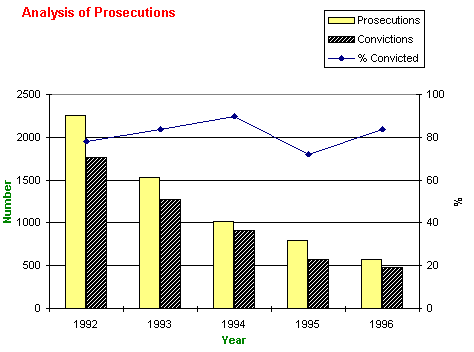
The number of prosecutions has dropped again and continues the trend of the last 5 years. At 572, it is now only 25% of the number taken in 1992. The conviction rate of 84% is in line with previous years. See Figure 1.
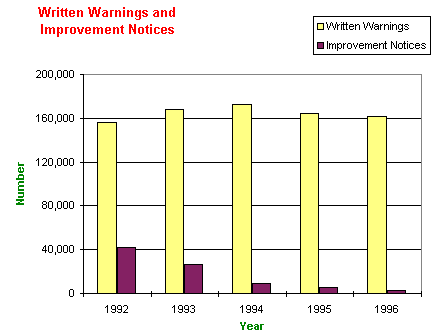
There was a further decline in the use of the improvement notice which also continues the trend of the last 5 years. At 3,119 it is now only 7.5% of the number issued in 1992. The number of written warnings has also dropped slightly but is in line with previous years. See Figure 2.
Data from Form B reflects the decline in prosecutions with drops in all the main categories. Data from Form C show a further slight drop in the number of formal samples (1996, 62,350; 1995, 63,726). The number of unsatisfaory samples has declined slightly (1996, 19,035; 1995, 21,642) but the resulting number of prosecution has dropped by about one third (1996, 216; 1995, 323). Overall this represent a prosecution rate of about 1.1%. The figure depends on the type of problem as is indicated in Figure 3. It will be seen that there was a decline in all categories

Data from Form D indicate a fall in the level of informal sampling (1996, 168,972; 1995, 183,327).
This page was first provided by David Jukes on 25th March 1998.