
“General Food Law” - EU Regulation 178/2002
Last updated: 26 March, 2024
On this page:
- Summary
- Regulation 178/2002
- UK Legislation
- Updating the Regulation (2018-2019)
- Adoption of Regulation 178/2002 (1999-2003)
Summary
When the European Economic Community was formed, the initial focus was on the removal of barriers to trade. Differences in technical requirements were seen to restrict trade and so initial European measures in the food law area focused on agreeing harmonised controls to replace different national measures. Initial measures included veterinary requirements for fresh meat (1963) and agreed lists of colour additives (1964). The process of adopting harmonised measures was however slow. The Internal Market programme (1985-1992) gave a significant boost to the number of agreed measures but also created some additional structures with new or updated “framework” controls for certain sectors (e.g. food additives, contaminants, foods for particular nutritional uses). Throughout this period, the focus had been on removing barriers to trade.
With the increase in trade, there were increasing issues linked to the safety of food products. The BSE crisis (early 1990s) in the UK was a major concern for food safety across the EU. The close relationship at that time between the process of scientific risk assessment and the more political risk management decisions was considered to have been a factor in the drop in consumer confidence in the control systems. Other safety issues occurred in other member states, most notably a dioxin contamination problem in Belgium (1999) linked to contaminated animal feed. There was a slow response from the authorities and a lack of records throughout the food chain to enable the detection and removal of suspect food - both in Belgium and in neighbouring countries where there were also contaminated products.
As a result of these issues, and with the creation of the World Trade Organisation (WTO) in 1995 with its Agreement on Sanitary and Phytosanitary Measures (SPS), it was recognised that the European Union needed to have a unified measure setting out more fundamental food law requirements and establishing systems for risk assessment and risk management. A White Paper on Food Safety was published by the Commission in 2000 and was quickly followed by a proposal for a general food law regulation. This was adopted quite rapidly and was published as Regulation 178/2002.
The Regulation provides
- Chapter I: Scope and Definitions - establishes the general objective of providing a “high level of consumer protection”; covers both food and feed; includes the definitions of “food” and “food business operator”.
- Chapter II: General Food Law - includes the major offences of selling food which fails to meet food safety requirements or which is presented in a misleading manner, establishes minimum traceability requirements and rules on product recall.
- Chapter III: European Food Safety Authority - establishes EFSA as the risk assessment body for food matters for the EU and sets out the key principles for its operation.
- Chapter IV: Rapid Alert System, Crisis Management and Emergencies - gives an updated legal basis for the Rapid Alert System for Food and Feed (RASFF) and for the authority for measures to be taken in a crisis or emergency.
- Chapter V: Procedures and Final Provisions
Under definitions, for the first time, the Regulation provided a definition of “food” for the purposes of all food law (see Article 2). In particular if defines the boundaries between “food” and other legislation. This is illustrated in this figure:
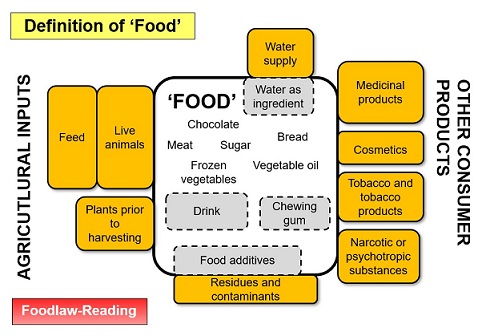
A larger version of this figure is available in pdf format: EU Definition of Food Figure
The Regulation provides a “top level” control and structure from which all other food law measures can be developed. Overall, the current food law system within the EU can be visualised as having the format illustrated in the figure:
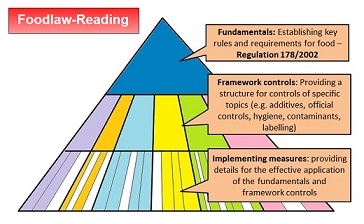
A larger version of this figure is available in pdf format: EU Food Law Structure
For the Commission's page on this Regulation, see: General Food Law. For the European Food Safety Authority, see EFSA.
Regulation 178/2002
- Regulation (EC) No 178/2002 of the European Parliament and of the Council of 28 January 2002 laying down the general principles and requirements of food law, establishing the European Food Safety Authority and laying down procedures in matters of food safety (OJ L31, 1.2.2002, page 1)
Amendments:- Regulation (EC) No 1642/2003 of the European Parliament and of the Council of 22 July 2003 amending Regulation (EC) No 178/2002 laying down the general principles and requirements of food law, establishing the European Food Safety Authority and laying down procedures in matters of food safety (OJ L245, 29.9.2003, page 4) [Updated EFSA financial rules and access to documents rules]
- Commission Regulation (EC) No 575/2006 of 7 April 2006 amending Regulation (EC) No 178/2002 of the European Parliament and of the Council as regards the number and names of the permanent Scientific Panels of the European Food Safety Authority (OJ L100, 8.4.2006, page 3) [Amendment to Scientific Panel names]
- Commission Regulation (EC) No 202/2008 of 4 March 2008 amending Regulation (EC) No 178/2002 of the European Parliament and of the Council as regards the number and names of the Scientific Panels of the European Food Safety Authority (OJ L 60, 5.3.2008, page 17) [Amendment to Scientific Panel names]
- Regulation (EC) No 596/2009 of the European Parliament and of the Council of 18 June 2009 adapting a number of instruments subject to the procedure referred to in Article 251 of the Treaty to Council Decision 1999/468/EC with regard to the regulatory procedure with scrutiny — Adaptation to the regulatory procedure with scrutiny — Part Four (OJ L188, 18.7.2009, page 14) [Adjustment to the regulatory procedure]
- Regulation (EU) No 652/2014 of the European Parliament and of the Council of 15 May 2014 laying down provisions for the management of expenditure relating to the food chain, animal health and animal welfare, and relating to plant health and plant reproductive material, amending Council Directives 98/56/EC, 2000/29/EC and 2008/90/EC, Regulations (EC) No 178/2002, (EC) No 882/2004 and (EC) No 396/2005 of the European Parliament and of the Council, Directive 2009/128/EC of the European Parliament and of the Council and Regulation (EC) No 1107/2009 of the European Parliament and of the Council and repealing Council Decisions 66/399/EEC, 76/894/EEC and 2009/470/EC (OJ L189, 27.6.2014, page 1) [Adjustment to funding controls]
- Commission Regulation (EU) 2017/228 of 9 February 2017 amending Regulation (EC) No 178/2002 of the European Parliament and of the Council as regards the names and the areas of competence of the scientific panels of the European Food Safety Authority (OJ L35, 10.2.2017, page 10) [Amendment to Scientific Panel names]
- Regulation (EU) 2019/1243 of the European Parliament and of the Council of 20 June 2019 adapting a number of legal acts providing for the use of the regulatory procedure with scrutiny to Articles 290 and 291 of the Treaty on the Functioning of the European Union (OJ L198, 25.7.2019, page 241) [Provides increased authority to the Commission to adopt delegated legislation]
- Regulation (EU) 2019/1381 of the European Parliament and of the Council of 20 June 2019 on the transparency and sustainability of the EU risk assessment in the food chain and amending Regulations (EC) No 178/2002, (EC) No 1829/2003, (EC) No 1831/2003, (EC) No 2065/2003, (EC) No 1935/2004, (EC) No 1331/2008, (EC) No 1107/2009, (EU) 2015/2283 and Directive 2001/18/EC (OJ L231, 6.9.2019, page 1) [Provides an extensive updating of the requirements linked, in particular, to increased transparency of the risk assessment process]
- Commission Delegated Regulation (EU) 2024/908 of 17 January 2024 amending Regulation (EC) No 178/2002 of the European Parliament and of the Council as regards the number and names of the permanent Scientific Panels of the European Food Safety Authority (OJ L, 2024/908, 20.3.2024)
For the latest consolidated version, see: Regulation 178/2002 - Consolidated (July 2019)
UK Legislation
Before the adoption of EU Regulation 178/2002, the primary legislation for food was the Food Safety Act 1990. That Act remains important and it sets out many of the key legal processes for the effective application of food controls in England, Wales and Scotland - for Northern Ireland similar controls are contained in the Food Safety (Northern Ireland) Order 1991. The information below relates only to the application of the legal requirements introduced by Regulation 178/2002.
Brexit: Prior to the IP Completion Day (31 December 2020), the legal requirements given in the EU Regulation 178/2020 still applied to the UK. Since IP Completion Day, the Regulation 178/2002 has been incorporated into UK legislation but with amendments to correct deficiencies. Information on this is given below. For more details of the process of incorporating EU legislation into UK law, see the separate page: UK Food Law: EU Legislation as Amended for the UK. Provisions for the enforcement of the controls (originally the EU Regulations but now as amended) have been provided in the UK Regulations listed below. For Northern Ireland, EU rules still apply.
1 January 2021: For interim guidance, see:
- Food Standards Agency: General Food Law. See: https://www.food.gov.uk/business-guidance/general-food-law
EU Legislation with links to legislation.gov.uk: as amended for application in the UK:
Note that the amending Regulation, Regulation (EU) 2019/1381, was only to be applied in the EU from 27 March 2021.
- Regulation (EC) No. 178/2002 of the European Parliament and of the Council laying down the general principles and requirements of food law, establishing the European Food Safety Authority and laying down procedures in matters of food safety as amended by:
- General Food Law (Amendment etc.) (EU Exit) Regulations 2019 (SI 2019, No. 641) as amended by:
- Food and Feed Hygiene and Safety (Miscellaneous Amendments etc.) (EU Exit) Regulations 2020 (SI 2020, No. 1504)
- Food and Feed Hygiene and Safety (Miscellaneous Amendments) (EU Exit) Regulations 2019 (SI 2019, No. 1013) [Note: Revoked by 2020, No. 1504]
- General Food Law (Amendment etc.) (EU Exit) Regulations 2019 (SI 2019, No. 641) as amended by:
Enforcement
As a key “high level” document, implementation of Regulation 178/2002 required an amendment to the Food Safety Act 1990 and, for Northern Ireland, the Food Safety (Northern Ireland) Order 1991, In particular, these incorporated the modified definition of “food”. Other aspects were implemented by adoption of “General Food Regulations”.
Great Britain (England, Wales and Scotland)
- General Food Regulations 2004 (SI 2004, No. 3279) as amended by:
- Official Feed and Food Controls (Scotland) Regulations 2005 (SSI 2005, No. 616)
- Official Feed and Food Controls (England) Regulations 2005 (SI 2005, No. 2626)
- Official Feed and Food Controls (Wales) Regulations 2005 (SI 2005, No. 3254 (W.247))
- Food Safety, Food Hygiene and Official Controls (Sprouting Seeds) (Scotland) Regulations 2013 (SSI 2013, No. 333)
- Food Safety and Hygiene (England) Regulations 2013 (SI 2013, No. 2996) [Replaced and revoked, for England, Regulations 3, 4, 5, 6, 6A and 7]
- Food Safety, Food Hygiene and Official Controls (Sprouting Seeds) (Wales) Regulations 2013 (SI 2013, No. 3007 (W.298))
- Food Safety, Food Hygiene and Official Controls (Sprouting Seeds) (Scotland) Regulations 2013 (SSI 2013, No. 333)
- Food (Scotland) Act 2015 (Consequential Provisions) (No. 2) Order 2015 (SSI 2015, No. 433)
- Food and Feed Safety and Hygiene (EU Exit) (Scotland) (Amendment) Regulations 2019 (SSI 2019, No. 52) as amended by:
- Food and Feed (EU Exit) (Scotland) (Amendment) Regulations 2020 (SSI 2020, No. 372)
- Food and Feed Hygiene and Safety (Miscellaneous Amendments) (Wales) (EU Exit) Regulations 2019 (SI 2019, No. 434 (W.102))
- Food (Miscellaneous Amendments) (Wales) (EU Exit) (No. 2) Regulations 2019 (SI 2019, No. 1046 (W.185))
- Food and Feed Hygiene and Safety (Miscellaneous Amendments and Saving Provision) (Wales) (EU Exit) Regulations 2020 (SI 2020, No. 1581 (W.331))
- Food Safety and Hygiene (England) Regulations 2013 (SI 2013, No. 2996) [Replaced and revoked, for England, Regulations 3, 4, 5, 6, 6A and 7 of General Food Regulations 2004] as amended by:
- Official Feed and Food Controls (England) and the Food Safety and Hygiene (England) (Amendment) Regulations 2014 (SI 2014, No. 2748)
- Food Safety and Hygiene (England) (Amendment) Regulations 2014 (SI 2014, No. 2885)
- General Food Law (Amendment etc.) (EU Exit) Regulations 2019 (SI 2019, No. 641) as amended by:
- Food and Feed Hygiene and Safety (Miscellaneous Amendments etc.) (EU Exit) Regulations 2020 (SI 2020, No. 1504)
- Food and Feed Hygiene and Safety (Miscellaneous Amendments) (EU Exit) Regulations 2019 (SI 2019, No. 1013) [Note: Revoked by 2020, No. 1504]
- Official Feed and Food Controls (England) (Miscellaneous Amendments) Regulations 2019 (SI 2019, No. 1476)
- Food and Feed Hygiene and Safety (Miscellaneous Amendments) (England) Regulations 2020 (SI 2020, No. 1410)
- Food Safety Act 1990 (Amendment) Regulations 2004 (SI 2004, No. 2990)
Northern Ireland
- General Food Regulations (Northern Ireland) 2004 (SRNI 2004, No. 505) as amended by:
- Official Feed and Food Controls Regulations (Northern Ireland) 2005 (SRNI 2005, No. 574)
- Food Safety, Food Hygiene and Official Controls (Sprouting Seeds and Miscellaneous Amendments) Regulations (Northern Ireland) 2013 (SRNI 2013, No. 291)
- Food (Miscellaneous Amendments and Revocations) Regulations (Northern Ireland) 2019 (SRNI 2019, No. 5)
- Food and Feed Hygiene and Safety (Amendment) (Northern Ireland) (EU Exit) Regulations 2019 (SI 2019, No. 652) [Note: revoked by SI 2020 No 1504]
- Food and Feed Hygiene and Safety (Amendment No.2) (Northern Ireland) (EU Exit) Regulations 2019 (SI 2019, No. 1085) [Note: revoked by SI 2020 No 1504]
- Food Safety (Northern Ireland) Order 1991 (Amendment) Regulations (Northern Ireland) 2004 (SRNI 2004, No. 482)
Updating the Regulation (2018 - 2019)
As part of the general “Regulatory Fitness and Performance Programme” (REFIT), the Commission undertook a “Fitness Check” of Regulation 178/2002 based on a mandate published in early 2014. The report on this “Refit Evaluation” was published in January 2018. In April 2018 the Commission published a proposal to make amendments to Regulation 178/2002. This forms the basis of discussions currently in progress on updating the Regulation. The Regulation was adopted by the Council in June 2019 and published in the Official Journal in September.
Key Documents
- Mandate: REFIT Fitness Check of Regulation (EC) No 178/2002
Provides the justification and objectives of the study - published 2014. - Commission Staff Working Document - Refit Evaluation of the General Food law (Regulation (EC) No 178/2002)
The complete report of the study published in January 2018. Also available is an “Executive Summary”. Appendices to the report can be accessed from the Commission page: Fitness Check of General Food Law. - COM/2018/179: Proposal for a REGULATION OF THE EUROPEAN PARLIAMENT AND OF THE COUNCIL on the transparency and sustainability of the EU risk assessment in the food chain amending Regulation (EC) No 178/2002 [on general food law], Directive 2001/18/EC [on the deliberate release into the environment of GMOs], Regulation (EC) No 1829/2003 [on GM food and feed], Regulation (EC) No 1831/2003 [on feed additives], Regulation (EC) No 2065/2003 [on smoke flavourings], Regulation (EC) No 1935/2004 [on food contact materials], Regulation (EC) No 1331/2008 [on the common authorisation procedure for food additives, food enzymes and food flavourings], Regulation (EC) No 1107/2009 [on plant protection products] and Regulation (EU) No 2015/2283 [on novel foods]. Published April 2018.
- Provisional Agreement Resulting from Interinstitutional Negotiations: Proposal for a regulation of the European Parliament and of the Council on the transparency and sustainability of the EU risk assessment in the food chain amending Regulation (EC) No 178/200…
Following both the European Parliament and the Council adopting positions (in December 2018) on the proposal, interinstitutional discussions were held and a compromise text agreed. This is subject to agreement of both the Parliament and the Council. Document published: 15 February 2019 - REGULATION OF THE EUROPEAN PARLIAMENT AND OF THE COUNCIL on the transparency and sustainability of the EU risk assessment in the food chain and amending Regulations (EC) No 178/2002, (EC) No 1829/2003, (EC) No 1831/2003, (EC) No 2065/2003, (EC) No 1935/2004, (EC) No 1331/2008, (EC) No 1107/2009, (EU) 2015/2283 and Directive 2001/18/E
The regulation was adopted by the Council on 13 June 2019. Until its publication in the Official Journal, the text adopted by the Council is available on the Council website - Fact Sheet New legislation on transparency and sustainability of the EU risk assessment model in the food chain
A copy of a Commission supporting “Fact Sheet” (published 13 June 2019) is available on this site. - Regulation (EU) 2019/1381 of the European Parliament and of the Council of 20 June 2019 on the transparency and sustainability of the EU risk assessment in the food chain and amending Regulations (EC) No 178/2002, (EC) No 1829/2003, (EC) No 1831/2003, (EC) No 2065/2003, (EC) No 1935/2004, (EC) No 1331/2008, (EC) No 1107/2009, (EU) 2015/2283 and Directive 2001/18/EC (OJ L231, 6.9.2019, page 1)
The adopted Regulation published in the Official Journal on the 6 September 2019.
News items relating to the progress of this proposal:
- 15 January 2018 Results of the Fitness Check (REFIT) on the General Food Law Regulation (Regulation (EC) No 178/2002)
- 23 January 2018 Public Consultation on the transparency and sustainability of the EU risk assessment in the food chain
- 11 April 2018 EU Commission wants to end secrecy around food safety assessment [Publication of proposal]
- 11 April 2018 Commission acts to boost trust in scientific studies on food safety
- 20 June 2018 BEUC Publication: Closing the Trust Gap Between Consumers and the EU Food Regulatory System
- 17 October 2018 Don't delay General Food Law, BEUC urges Members of European Parliament
- 26 November 2018 EU Parliament's ENVI committee must vote to end secrecy around food safety assessments
- 27 November 2018 EU Parliament: EU food watchdog: more transparency, better risk prevention
- 11 December 2018 BEUC Comments: EU Parliament votes to lift the veil on food safety assessments [Parliament's First Reading completed]
- 11 December 2018 Food safety: more transparency, better risk prevention
- 12 December 2018 More transparent scientific studies on food safety: Council agrees its position
- 17 December 2018 Regulation amending general food law - General approach [Council adopts position]
- 11 February 2019 Boosting trust in scientific studies on food safety: Commission welcomes the provisional agreement reached today
- 12 February 2019 Food safety: Enhancing consumer trust in EU risk assessment and authorisation
- 19 February 2019 FoodDrinkEurope: Statement on transparency of EU risk assessment model
- 17 April 2019 Food safety: New rules to boost consumer trust approved by MEPs [Parliament's Second Reading completed]
- 17 April 2019 Commission welcomes the vote in the European Parliament on Commission's proposal for boosting trust in scientific studies on food safety
- 17 April 2019 FoodDrinkEurope statement on General Food Law reform
- 17 April 2019 BEUC Statement: EU Parliament votes for more transparency of food safety studies
- 13 June 2019 Boosting trust in scientific studies on food safety: the Commission welcomes Council adoption of new rules for a more transparent risk assessment process
The Adoption of Regulation 178/2002 (1999-2003)
The following are some of the stages in the process of adopting the Regulation:
- COM(97) 176: The General Principles of Food Law in the European Union - Commission Green Paper
With the issues arising from the BSE crisis needing to be resolved (and before the Belgium dioxin crisis), the Commission had started consideration of how to provide top-level legislation for food law. This “Green Paper” was a discussion document on options issued in April 1997. - A European Food and Public Health Authority - The future of scientific advice in the EU
A stage in the process of moving to a new system for scientific advice. A report published in December 1999. - COM (1999) 719: White Paper on Food Safety
This Commission document set out the programme of work designed to modernise the food law structure for the European Union. A major element of this was the plan to adopt a new general food law. Adopted by the Commission in late 1999, it was published in January 2000. - COM(2000)716: Proposal for a Regulation of the European Parliament and of the Council laying down the general principles and requirements of food law, establishing the European Food Authority, and laying down procedures in matters of food
The original proposal issued in November 2000.
Relevant news items on this site (1999-2003):
- 4-8 October 1999 Food safety top priority says Commission President
- 13 December 1999 Scientists recommend Food and Health Authority to advise the EU
- 20 December 1999 Presidency Conclusions Helsinki European Council (10 and 11 December 1999)
- 12 January 2000 Commission adopts White Paper on Food Safety and sets out a “Farm to Table” legislative action programme
- 27 January 2000 Agriculture Council
- 16 March 2000 Council Open Debate - White Paper on Food Safety
- 13 April 2000 White Paper on Food Safety
- 19 April 2000 Scientific Steering Committee Issues Opinions
- 22 May 2000 Commission to renew scientific committees on consumer health and food safety
- 24 May 2000 Select Committee Reports: European Union Seventh Report: A European Food Authority
- 24 May 2000 The ESC's response to the European Commission's White Paper on Food Safety
- 29 May 2000 Internal Market Council Minutes: White Paper on Food Safety / Honey / Chocolate and Cocoa
- 1 June 2000 UK Government Supports Establishment of a European Food Authority
- 13 June 2000 White paper on food safety / Precautionary Principle
- 19/20 June 2000 Presidency Conclusions - Santa Maria Da Feira European Council
- 26 June 2000 European Food Authority Must Not Be Mere Window Dressing
- 11 October 2000 Towards a European Food Safety Authority
- 23 October 2000 Towards a European food safety authority
- 25 October 2000 Remarks by David Byrne (European Commissioner for Health and Consumer Protection) at the conclusion of the debate on the White Paper on Food Safety - European Parliament, Strasbourg
- 25 October 2000 Support for Food Safety Authority - Report on the Commission White Paper on food safety
- 8 November 2000 Food law from farm to table - Creating a European Food Authority
- 9 December 2000 Presidency Conclusions - Nice European Council meeting - 7, 8 and 9 December 2000
- 12 December 2000 Renewal of Scientific Committees Completed
- 16 January 2001 Proposed Council/EP Regulation Laying Down General Principles of Food Law and Establishing the European Food Authority (EFA)
- 21 February 2001 Proposed Council/EP Regulation Laying Down General Principles of Food Law and Establishing the European Food Authority (EFA)
- 12 March 2001 Council Meeting: Internal Market/Consumer Affairs/Tourism
- 28 March 2001 Proposed Council/EP Regulation Laying Down General Principles of Food Law and Establishing the European Food Authority (EFA)
- 30 March 2001 Food safety: the EU must focus on results and preventive measures, says European ESC
- 3 April 2001 Budgetary guidelines 2002 - Food Safety and CAP reform a priority
- 12 April 2001 Proposed Council/EP Regulation Laying Down General Principles of Food Law and Establishing the European Food Authority (EFA)
- 24 April 2001 2343rd Council meeting - AGRICULTURE
- 7 May 2001 Preparations for setting up the EFA Advisory Forum launched in Brussels
- 29 May 2001 Proposed Council/EP Regulation Laying Down General Principles of Food Law and Establishing the European Food Authority (EFA)
- 29 May 2001 Environment Committee and Commission at odds over food law and EU Food Authority
- 30-31 May 2001 Council Minutes - 2351st Council meeting: Internal Market / Consumer Affairs / Tourism
- 8 June 2001 Food Authority Proposal Attracts 200 Amendments
- 12 June 2001 Support for Food Safety Authority
- 12 June 2001 Byrne welcomes adoption of European Parliament report on establishment of European Food Authority
- 15 June 2001 Göteborg European Council: Presidency Conclusions
- 28 June 2001 Transport / Telecommunications Council Meeting, 27/28 June 2001
- 28 June 2001 European Food Authority: Political agreement in Council
- 23 August 2001 Proposed EP/Council Regulation Laying Down the General Principles and Requirements of Food Law, Establishing the European Food Authority, and Laying Down Procedures in Matters of Food Safety
- 27 September 2001 General Food Law and the European Food Authority: Speech by David BYRNE to the Internal Market, Consumer Affairs, Tourism Council
- 28 September 2001 Results of the Internal Market/Consumer Affairs/Tourism Council, 27th September 2001
- 14 November 2001 Preparation of the Health Council on 15 November 2001
- 22 November 2001 Strong backing from MEPs for “European Food Safety Authority”
- 11 December 2001 Strong backing from MEPs for “European Food Safety Authority”
- 11 December 2001 Prodi and Byrne welcome constructive EP position: Final agreement very close
- 15 December 2001 Presidency Conclusions European Council meeting in Laeken 14 and 15 December 2001
- 17 December 2001 Next steps for European Food Safety Authority (EFSA)
- 17 December 2001 UK Press Reports on the outcome of the European Council
- 21 January 2002 Agency welcomes the adoption of European Food Safety Authority
- 21 January 2002 European Food Safety Authority adopted - Council agrees key legislation putting a new European-wide food safety system in place
- 21 February 2002 Food Safety - First set of farm-to-table food safety measures take effect
- 27 February 2002 Commission seeks head of new European Food Safety Authority
- 8 April 2002 Commission adopts short-list of candidates for the Management Board
- 6 May 2002 Commission seeks head of European Food Safety Authority (Republication)
- 15 July 2002 Outcome of the Agriculture Council
- 12 September 2002 First board meeting of new food authority to be held next week
- 1 October 2002 Executive Director of the European Food Safety Authority nominated
- 23 October 2002 Green light for Geoffrey Podger to be head of European Food Safety Authority
- 2 December 2002 Head of food safety authority appointed
- 11 December 2002 European Food Safety Authority Board adopts budget under protest
- 22 January 2003 Management Board looks at key issues
- 6 March 2003 Increased co-operation in food safety assessment
- 19 March 2003 MEPs call for brake on funding for Food Safety Agency in response to proposed split between Helsinki and Parma
- 20 March 2003 More action at EFSA
- 25 March 2003 Food Safety Agency: full administrative budget to be released
- 10 April 2003 Wanted - EFSA Number 2
- 30 April 2003 Green light for appointment of EFSA scientists
- 27 May 2003 Now open for business
- 18 June 2003 Priorities and openness at EFSA
- 16 September 2003 EFSA Moves up a gear
- 3 December 2003 EFSA plans greater public involvement in its work
- 13 December 2003 Location of Permanent Seat Agreed - Parma, Italy
- 15 December 2003 EFSA welcomes decision on permanent location
This page was first provided on 13 December 2018