Food Contact Materials and Articles
Last updated: 18 August, 2023
On this page:
- Summary - Brief details of the chronology of developments linked to this topic
- EU Legislation - Listing of Regulations covering the topic
- UK Legislation - Listing of Regulations covering the topic
- Guidance - Links to recommended supporting documents
Summary
EU legislation on “materials and articles in contact with food” was first adopted in 1976 by Directive 76/893/EEC. The main requirement was that:
Materials and articles must be manufactured in compliance with good manufacturing practice, so that, under their normal or foreseeable conditions of use, they do not transfer their constituents to foodstuffs in quantities which could:
- endanger human health,
- bring about an unacceptable change in the composition of the foodstuffs or a deterioration in the organoleptic characteristics thereof.
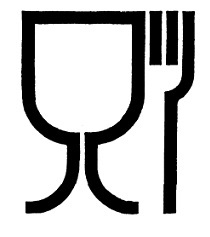
A supporting Directive (Directive 80/590) provided for the use of a standardised symbol to indicate that an article was suitable for food use:
An updated framework Directive was adopted in late 1988 and published as Directive 89/109. This included a listing of 10 groups for which it was considered appropriate to have more detailed specific directives. The list included the following:
- Plastics, including varnish and coatings / Regenerated cellulose / Elastomers and rubber / Paper and board / Ceramics / Glass / Metals and alloys / Wood, including cork / Textile products / Paraffin waxes and micro-crystalline waxes
In 2004, the framework control was replaced by Regulation 1935/2004 (see below). It added some additional requirements for “active and intelligent materials and articles” and extended the listing of potential specific controls to include the following groups:
- Active and intelligent materials and articles / Adhesives / Cork / Rubbers / Ion-exchange resin / Printing inks / Silicones
The Regulation also incorporated the provision relating to the use of the standardised symbol.
Although the 1989 Directive and the current 2004 Regulation identified groups of materials and articles needing specific controls, only a limited number of these have been adopted to date. The following diagram indicates those which have been progressed and those still awaiting adoption:
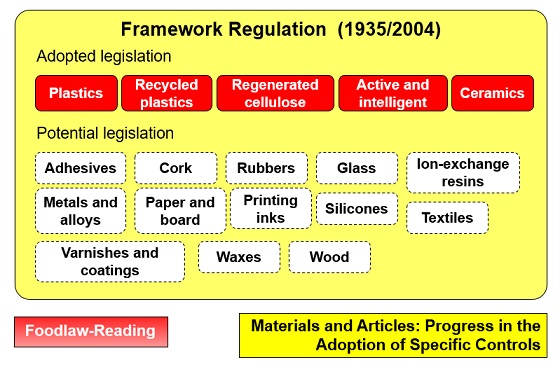
A larger version of this image is available as a pdf file. See: EU Materials and Articles Controls
For the Commission's page on this topic, see: Food Contact Materials.
EU Law
Framework Regulation:
- Regulation (EC) No 1935/2004 of the European Parliament and of the Council of 27 October 2004 on materials and articles intended to come into contact with food and repealing Directives 80/590/EEC and 89/109/EEC
- Amendments:
- Regulation (EC) No 596/2009 of the European Parliament and of the Council of 18 June 2009 adapting a number of instruments subject to the procedure referred to in Article 251 of the Treaty to Council Decision 1999/468/EC with regard to the regulatory procedure with scrutiny — Adaptation to the regulatory procedure with scrutiny — Part Four
- Regulation (EU) 2019/1381 of the European Parliament and of the Council of 20 June 2019 on the transparency and sustainability of the EU risk assessment in the food chain and amending Regulations (EC) No 178/2002, (EC) No 1829/2003, (EC) No 1831/2003, (EC) No 2065/2003, (EC) No 1935/2004, (EC) No 1331/2008, (EC) No 1107/2009, (EU) 2015/2283 and Directive 2001/18/EC (OJ L231, 6.9.2019, page 1)
A consolidated version of the Regulation is also available. See Regulation 1935/2004 - Consolidated Version (dated March 2021 when Regulation 2019/1381 came into effect).
An additional supporting control was also adopted:
- Commission Regulation (EC) No 2023/2006 of 22 December 2006 on good manufacturing practice for materials and articles intended to come into contact with food (OJ L 384, 29.12.2006, page 75)
Amendment:- Commission Regulation (EC) No 282/2008 of 27 March 2008 on recycled plastic materials and articles intended to come into contact with foods and amending Regulation (EC) No 2023/2006 (OJ L86, 28.3.2008, page 9)
Specific Regulations:
Plastics
- Commission Regulation (EU) No 10/2011 of 14 January 2011 on plastic materials and articles intended to come into contact with food (OJ L12, 15.1.2011, page 1)
Amendments:- Commission Implementing Regulation (EU) No 321/2011 of 1 April 2011 amending Regulation (EU) No 10/2011 as regards the restriction of use of Bisphenol A in plastic infant feeding bottles Text with EEA relevance (OJ L87, 2.4.2011, page 1)
- Commission Regulation (EU) No 1282/2011 of 28 November 2011 amending and correcting Commission Regulation (EU) No 10/2011 on plastic materials and articles intended to come into contact with food (OJ L328, 10.12.2011, page 22)
- Commission Regulation (EU) No 1183/2012 of 30 November 2012 amending and correcting Regulation (EU) No 10/2011 on plastic materials and articles intended to come into contact with food (OJ L338, 12.12.2012, page 11)
- Corrigendum to Commission Regulation (EU) No 1183/2012 of 30 November 2012 amending and correcting Regulation (EU) No 10/2011 on plastic materials and articles intended to come into contact with food (OJ L338, 12.12.2012) (OJ L349, 19.12.2012, page 77)
- Commission Regulation (EU) No 202/2014 of 3 March 2014 amending Regulation (EU) No 10/2011 on plastic materials and articles intended to come into contact with food (OJ L62, 4.3.2014, page 13)
- Commission Regulation (EU) 2015/174 of 5 February 2015 amending and correcting Regulation (EU) No 10/2011 on plastic materials and articles intended to come into contact with food (OJ L30, 6.2.2015, page 2)
- Commission Regulation (EU) 2016/1416 of 24 August 2016 amending and correcting Regulation (EU) No 10/2011 on plastic materials and articles intended to come into contact with food (OJ L230, 25.8.2016, page 22)
- Commission Regulation (EU) 2017/752 of 28 April 2017 amending and correcting Regulation (EU) No 10/2011 on plastic materials and articles intended to come into contact with food (OJ L113, 29.4.2017, page 18)
- Commission Regulation (EU) 2018/79 of 18 January 2018 amending Regulation (EU) No 10/2011 on plastic materials and articles intended to come into contact with food (OJ L14, 19.1.2018, page 31)
- Commission Regulation (EU) 2018/213 of 12 February 2018 on the use of bisphenol A in varnishes and coatings intended to come into contact with food and amending Regulation (EU) No 10/2011 as regards the use of that substance in plastic food contact materials (OJ L41, 14.2.2018, page 6)
- Commission Regulation (EU) 2018/831 of 5 June 2018 amending Regulation (EU) No 10/2011 on plastic materials and articles intended to come into contact with food (OJ L140, 6.6.2018, page 35)
- Commission Regulation (EU) 2019/37 of 10 January 2019 amending and correcting Regulation (EU) No 10/2011 on plastic materials and articles intended to come into contact with food (OJ L9, 11.1.2019, page 88)
- Commission Regulation (EU) 2019/1338 of 8 August 2019 amending Regulation (EU) No 10/2011 on plastic materials and articles intended to come into contact with food (OJ L209, 9.8.2019, page 5)
- Commission Regulation (EU) 2020/1245 of 2 September 2020 amending and correcting Regulation (EU) No 10/2011 on plastic materials and articles intended to come into contact with food (OJ L288, 3.9.2020, page 1)
- Commission Regulation (EU) 2023/1442 of 11 July 2023 amending Annex I to Regulation (EU) No 10/2011 on plastic materials and articles intended to come into contact with food, as regards changes to substance authorisations and addition of new substances (OJ L 177, 12.7.2023, page 45)
- Commission Regulation (EU) 2023/1627 of 10 August 2023 amending Annex I to Regulation (EU) No 10/2011 as regards the authorisation of the substance bis(2-ethylhexyl)cyclohexane-1,4-dicarboxylate (FCM No 1079) (OJ L 201, 11.8.2023, page 4)
A consolidated version of the Regulation is also available. See: Regulation (EU) No 10/2011 - Consolidated version (September 2020).
Recycled Plastics
The controls on recycled plastic materials and articles have been updated. Most of the new Regulation (2022/1616) comes into effect on 10 October 2022. There are though transitional provisions. Also certain new provisions relating to testing and certification will only enter into force on 20 October 2024.
- Commission Regulation (EU) 2022/1616 of 15 September 2022 on recycled plastic materials and articles intended to come into contact with foods, and repealing Regulation (EC) No 282/2008 (OJ L 243, 20.9.2022, page 3)
Correction:- Corrigendum to Commission Regulation (EU) 2022/1616 of 15 September 2022 on recycled plastic materials and articles intended to come into contact with foods, and repealing Regulation (EC) No 282/2008 (OJ L 243, 20.9.2022) (OJ L 244, 21.9.2022, page 70)
Former Regulation:
- Commission Regulation (EC) No 282/2008 of 27 March 2008 on recycled plastic materials and articles intended to come into contact with foods and amending Regulation (EC) No 2023/2006 (OJ L86, 28.3.2008, page 9)
Amendment:- Commission Regulation (EU) 2015/1906 of 22 October 2015 amending Regulation (EC) No 282/2008 on recycled plastic materials and articles intended to come into contact with foods (OJ L278, 23.10.2015, page 11)
A consolidated version of the Regulation is also available. See: Regulation 282/2008 - Consolidated version (October 2015)
Regenerated Cellulose
- Commission Directive 2007/42/EC of 29 June 2007 relating to materials and articles made of regenerated cellulose film intended to come into contact with foodstuffs (OJ L172, 30.6.2007, page 71)
Active and Intelligent Material and Articles
- Commission Regulation (EC) No 450/2009 of 29 May 2009 on active and intelligent materials and articles intended to come into contact with food (OJ L135, 30.5.2009, page 3)
Supporting document:
- Register of substances with a valid application for authorisation (Regulation (EC) No 450/2009 - active and intelligent materials and articles) (Commission publication: June 2012)
Ceramics
- Council Directive 84/500/EEC of 15 October 1984 on the approximation of the laws of the Member States relating to ceramic articles intended to come into contact with foodstuffs (OJ L277, 20.10.1984, page 12)
Miscellaneous
- Commission Directive 93/11/EEC of 15 March 1993 concerning the release of the N-nitrosamines and N- nitrosatable substances from elastomer or rubber teats and soothers (OJ L93, 17.4.1993, page 37)
- Commission Regulation (EC) No 1895/2005 of 18 November 2005 on the restriction of use of certain epoxy derivatives in materials and articles intended to come into contact with food (OJ L302, 19.11.2005, page 28)
- Commission Regulation (EU) 2018/213 of 12 February 2018 on the use of bisphenol A in varnishes and coatings intended to come into contact with food and amending Regulation (EU) No 10/2011 as regards the use of that substance in plastic food contact materials (OJ L41, 14.2.2018, page 6)
UK Legislation
Brexit: Prior to the IP Completion Day (31 December 2020), the legal requirements given in the EU Regulations listed above still applied to the UK. Since IP Completion Day, the EU Regulations above have been incorporated into UK legislation but with amendments to correct deficiencies. Information on this is given below. For more details of the process of incorporating EU legislation into UK law, see the separate page: UK Food Law: EU Legislation as Amended for the UK. Provisions for the enforcement of the controls (originally the EU Regulations but now as amended) have been provided in the UK Regulations listed below. For Northern Ireland, EU rules still apply.
Guidance:
EU Legislation with links to legislation.gov.uk: amended for application in Great Britain:
- Regulation (EC) No. 1935/2004 of the European Parliament and of the Council on materials and articles intended to come into contact with food as amended by:
- Materials and Articles in Contact with Food (Amendment) (EU Exit) Regulations 2019 (SI 2019, No. 704)
- Food and Feed Hygiene and Safety (Miscellaneous Amendments) (EU Exit) Regulations 2019 (SI 2019, No. 1013)[Revoked by 2020, No. 1504]
- Commission Regulation (EU) No. 10/2011 on plastic materials and articles intended to come into contact with food as amended by:
- Materials and Articles in Contact with Food (Amendment) (EU Exit) Regulations 2019 (SI 2019, No. 704) as amended by:
- Food and Feed Hygiene and Safety (Miscellaneous Amendments etc.) (EU Exit) Regulations 2020 (SI 2020, No. 1504)
- Food and Feed Hygiene and Safety (Miscellaneous Amendments) (EU Exit) Regulations 2019 (SI 2019, No. 1013)[Revoked by 2020, No. 1504]
- Materials and Articles in Contact with Food (Amendment) (EU Exit) Regulations 2019 (SI 2019, No. 704) as amended by:
- Commission Regulation (EC) No. 282/2008 on recycled plastic materials and articles intended to come into contact with food … as amended by:
- Materials and Articles in Contact with Food (Amendment) (EU Exit) Regulations 2019 (SI 2019, No. 704) as amended by:
- Food and Feed Hygiene and Safety (Miscellaneous Amendments etc.) (EU Exit) Regulations 2020 (SI 2020, No. 1504)
- Food and Feed Hygiene and Safety (Miscellaneous Amendments) (EU Exit) Regulations 2019 (SI 2019, No. 1013)[Revoked by 2020, No. 1504]
- Materials and Articles in Contact with Food (Amendment) (EU Exit) Regulations 2019 (SI 2019, No. 704) as amended by:
- Commission Regulation (EC) No. 450/2009 on active and intelligent materials and articles intended to come into contact with food as amended by:
- Materials and Articles in Contact with Food (Amendment) (EU Exit) Regulations 2019 (SI 2019, No. 704) as amended by:
- Food and Feed Hygiene and Safety (Miscellaneous Amendments etc.) (EU Exit) Regulations 2020 (SI 2020, No. 1504),
- Food and Feed (Miscellaneous Amendments) Regulations 2022 (SI 2022, No. 1351)
- Materials and Articles in Contact with Food (Amendment) (EU Exit) Regulations 2019 (SI 2019, No. 704) as amended by:
- Commission Regulation (EC) No. 1895/2005 on the restriction of use of certain epoxy derivatives in materials and articles intended to come into contact with food as amended by:
- Materials and Articles in Contact with Food (Amendment) (EU Exit) Regulations 2019 (SI 2019, No. 704) as amended by:
- Food and Feed Hygiene and Safety (Miscellaneous Amendments etc.) (EU Exit) Regulations 2020 (SI 2020, No. 1504)
- Materials and Articles in Contact with Food (Amendment) (EU Exit) Regulations 2019 (SI 2019, No. 704) as amended by:
- Commission Regulation (EU) 2018/213 on the use of bisphenol A in varnishes and coatings intended to come into contact with food and amending Regulation (EU) No 10/2011 as regards the use of that substance in plastic food contact materials as amended by:
- Materials and Articles in Contact with Food (Amendment) (EU Exit) Regulations 2019 (SI 2019, No. 704) as amended by:
- Food and Feed Hygiene and Safety (Miscellaneous Amendments etc.) (EU Exit) Regulations 2020 (SI 2020, No. 1504)
- Materials and Articles in Contact with Food (Amendment) (EU Exit) Regulations 2019 (SI 2019, No. 704) as amended by:
UK Legislation based on EU Directives
Regenerated Cellulose / Ceramics (implementing Council Directive 84/500/EEC and Commission Directive 2007/42/EC)
- England
- Materials and Articles in Contact with Food (England) Regulations 2012 (SI 2012, No. 2619) as amended by:
- Materials and Articles in Contact with Food (Amendment) (EU Exit) Regulations 2019 (SI 2019, No. 704) as amended by:
- Food and Feed Hygiene and Safety (Miscellaneous Amendments etc.) (EU Exit) Regulations 2020 (SI 2020, No. 1504)
- Food and Feed Hygiene and Safety (Miscellaneous Amendments) (England) Regulations 2020 (SI 2020, No. 1410)
- Food and Feed (Miscellaneous Amendments) Regulations 2022 (SI 2022, No. 1351)
- Materials and Articles in Contact with Food (Amendment) (EU Exit) Regulations 2019 (SI 2019, No. 704) as amended by:
- Materials and Articles in Contact with Food (England) Regulations 2012 (SI 2012, No. 2619) as amended by:
- Wales
- Materials and Articles in Contact with Food (Wales) Regulations 2012 (SI 2012, No. 2705 (W.291)) [Revised] as amended by:
- Materials and Articles in Contact with Food (Wales) (Amendment) Regulations 2017 (SI 2017, No. 832 (W.202))
- Food and Feed (Miscellaneous Amendments and Revocations) (Wales) Regulations 2018 (SI 2018, No. 806 (W.162))
- Materials and Articles in Contact with Food (Wales) (Amendment) Regulations 2018 (SI 2018, No. 913 (W.179))
- Food and Feed Regulated Products (Miscellaneous Amendments) (Wales) (EU Exit) Regulations 2019 (SI 2019, No. 425 (W.99))
- Food (Miscellaneous Amendments) (Wales) (EU Exit) (No. 2) Regulations 2019 (SI 2019, No. 1046 (W.185))
- Materials and Articles in Contact with Food (Wales) Regulations 2012 (SI 2012, No. 2705 (W.291)) [Revised] as amended by:
- Scotland
- Materials and Articles in Contact with Food (Scotland) Regulations 2012 (SSI 2012, No. 318) [Revised] as amended by:
- Food (Miscellaneous Amendment and Revocation) (Scotland) Amendment Regulations 2013 (SSI 2013, No. 83)
- Food Safety (Sampling and Qualifications) (Scotland) Regulations 2013 (SSI 2013, No. 84)
- Food Information (Scotland) Regulations 2014 (SSI 2014, No. 312)
- Food (Scotland) Act 2015 (Consequential and Transitional Provisions) Order 2015 (SSI 2015, No. 100)
- Materials and Articles in Contact with Food (Scotland) Amendment Regulations 2019 (SSI 2019, No. 32)
- Food and Feed Safety and Hygiene (EU Exit) (Scotland) (Amendment) Regulations 2019 (SSI 2019, No. 52) as amended by:
- Food and Feed (EU Exit) (Scotland) (Amendment) Regulations 2020 (SSI 2020, No. 372)
- Materials and Articles in Contact with Food (Scotland) Regulations 2012 (SSI 2012, No. 318) [Revised] as amended by:
- Northern Ireland
- Materials and Articles in Contact with Food Regulations (Northern Ireland) 2012 (SRNI 2012, No. 384) as amended by:
- Materials and Articles in Contact with Food (Amendment) Regulations (Northern Ireland) 2017 (SRNI 2017, No. 157)
- Materials and Articles in Contact with Food (Amendment) Regulations (Northern Ireland) 2018 (SRNI 2018, No. 186)
- Food (Miscellaneous Amendments and Revocations) Regulations (Northern Ireland) 2019 (SRNI 2019, No. 5)
- Regulated Products (Amendment) (Northern Ireland) (EU Exit) Regulations 2019 (SI 2019, No. 849) [revoked by SI 2020 No 1504]
- Materials and Articles in Contact with Food Regulations (Northern Ireland) 2012 (SRNI 2012, No. 384) as amended by:
N-nitrosamines and N-nitrosatable Substances (implementing Commission Directive 93/11/EEC)
- N-nitrosamines and N-nitrosatable Substances in Elastomer or Rubber Teats and Dummies (Safety) Regulations 1995 (SI 1995, No. 1012) [All UK]
Enforcement
Requirements for implementation and enforcement are provided for the four parts of the United Kingdom.
For Contact Materials, enforcement provision are contained in the Regulations listed in the section above covering the implementation of EU Directives.
Guidance
- Food Contact Materials
A short descriptive leaflet on the EU controls for contact materials (2015) - Union Guidelines on Regulation (EU) No 10/2011 on plastic materials and articles intended to come into contact with food
A detailed guidance document produced by the Commission in 2014. See also: Union Guidance on Regulation (EU) No 10/2011 on plastic materials and articles intended to come into contact with food as regards information in the supply chain (2013) - Recycled Content Used in Plastic Packaging Applications
Published by the British Plastics Federation (BPF) in conjunction with the Cosmetic, Toiletry and Perfumery Association (CTPA) and the Food and Drink Federation (FDF) in April 2020. Provides answers to questions about measuring recycled content and highlights important regulatory and technical considerations.
This page was first provided on 16 August 2019